Blog #1 | Addressing the museum attendance and benefit gap: inequality, representative participation and implementation science
Suzanne MacLeod and Mark O’Neill, October 2023
The aim of these AHRC-funded workshops is to create a multidisciplinary research network which will address persistent inequalities in museum attendance and benefit.
Data from the official Taking Part Survey, which includes the attendance gap between Upper and Lower Socioeconomic Groups in England, show that it has increased from 22.7 percentage points (pp) to 24.7pp over the past 15 years. The same pattern is evident in the rest of the UK. Sociologically, museum visiting reflects the socioeconomic gradient, closely tracking inequalities in education, income, employment, mental health and other indicators of social wellbeing. This analysis is supported by decades of research in cultural sociology internationally which, regardless of methodological or theoretical approach, confirms that people who participate in and benefit from state-sponsored cultural forms including museums, are, in the main, from upper socio-economic groups and that the single most important predictor of museum visiting is not class, ethnicity or income but level of prior educational achievement. Population-level studies in the epidemiology of culture tell us that simply visiting a museum may have positive health benefits. This emphasises the unfairness in the current distribution of cultural resources and the way museums reflect and contribute to established inequalities in health and wellbeing.
Despite 40 years of concerted efforts by museums of all genres and scales, supported by national and local government policy and targeted investment, including more than £5 billion of Lottery Funding, the strategies used by museums in the UK to reduce inequalities in museum visiting are not working. Whilst pockets of positive transformation have been achieved, museums have failed to find ways to understand, consolidate, share and sustain progress. The current model of museum engagement is reflected in their approach to research, supported by national agencies’ approach to evaluation. These are focused on measuring the impact on participations of small-scale projects, usually without an evaluation framework linking the activities of individual museums to population level data, such as the DCMS Taking Part Survey, or the equivalents in Scotland, Wales and Northern Ireland. These studies also rarely engage with the sociological literature on inequality, so that museums’ current uses of research cannot offer insights into the larger question of representative participation. A key question for the network is whether the resource devoted to evaluating small scale projects could be better used in locating museum visiting in a deeper, research-based understanding of socioeconomic and cultural inequalities.
The Network aims to develop a research agenda, based on existing underused research and data, which sets out specific, testable hypotheses about whether museums can play a role in reducing inequality through more representative visiting and benefit and make credible claims about their contribution to society. The Network will test the assumption that if museums understand the extent to which the attendance and benefit gap is driven by societal factors, they may be able to develop interventions which are most likely to have an impact. These in turn would lead to a more effective focus for deploying and growing their research capacity to move beyond ‘intuitive’ approaches to inequality and social change.
That’s why this Network is so important. We will spend the next 18 months working to understand what data we already have, what data we can access that might tell us more about people who visit and, importantly, people who do not visit museums, and how we might build a Framework within which resource decisions could be evidence led and ongoing evaluation could be linked to macro level understandings of museum attendance and benefit.
Blog #2 | What do we mean by reducing the Attendance and Benefit Gap?
Mark O’Neill, May 2024
The purpose of an AHRC-funded network is not so much to do new research, as to gather an interdisciplinary team which will explore what is already known about an issue from new and different perspectives which are likely to aid understanding. This is done with two purposes in mind
- To set out a research agenda which will bring new insights to the subject area – in this case museum visiting and non-visiting
- To enlist scholars, especially from disciplines which have been less involved in studying the topic, in helping to address the research agenda
A good example of the kind how this stimulating shift in perspective can work happened recently in our network.
Museum Visiting and Social Inequality
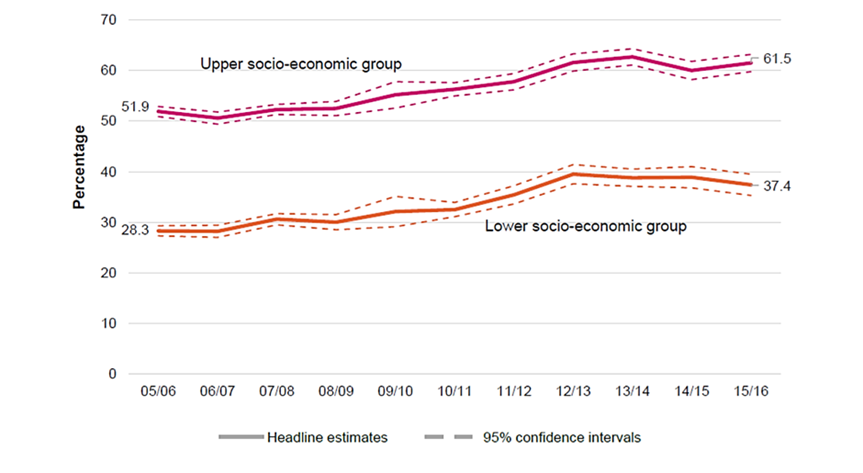
In the Taking Part Survey Focus On report on Museums and Galleries issued in 2017, the chart below (Figure 1) appeared.
It showed that attendance by those who visited museums at least once in the previous year increased amongst all social groups, but that the gap between Upper and Lower Socio-economic Groups (USEGs and LSEGs) remain more or less constant at c24 percentage points. Later editions of Taking Part show that this gap continues up to the present, and may have increased slightly (an increase is apparent, but it is within the margin of error). Understanding this persistent inequality is the focus of our research network – in the hope that understanding it will help us identify strategies for reducing it.
Another Reading
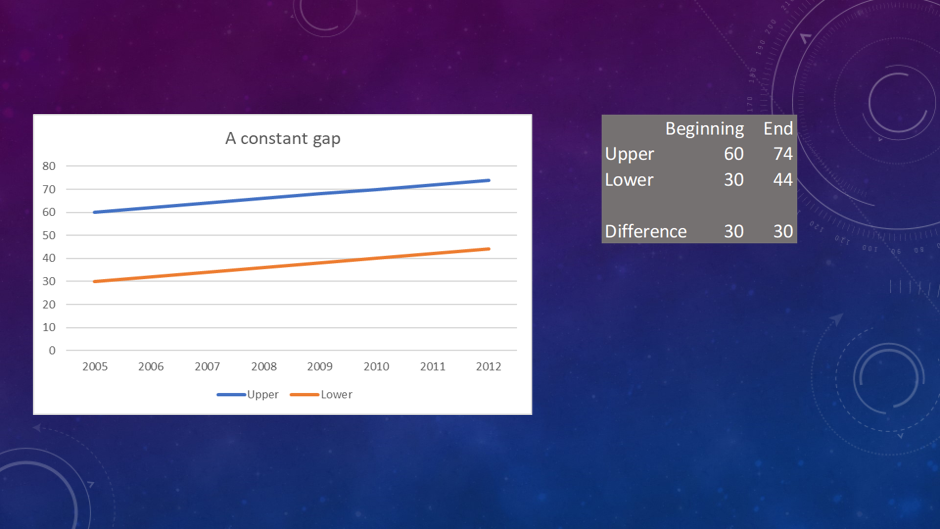
At a recent network workshop, Dr David Bartram, Associate Professor of Sociology in the School of Media, Communication and Sociology, at the University of Leicester. offered an alternative way of viewing the gap. He presented a simplified chart (Figure 2), which shares key characteristics with Figure 1. In Figure 2, both the upper and lower groups increase from the start time to the end date and a constant gap is maintained; in this case it’s 30 percentage points.
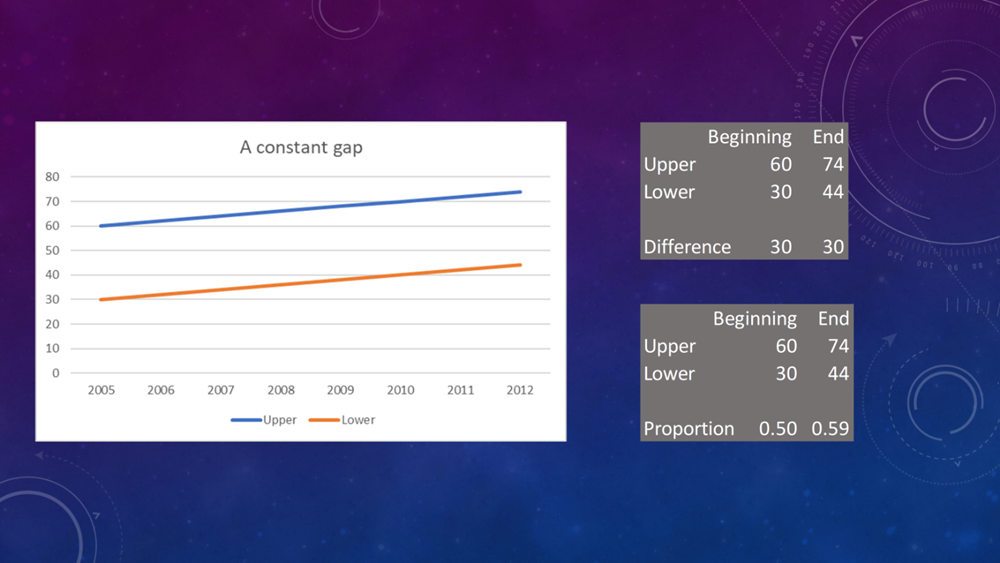
In Figure 3 however, David has added a second analysis box which sets out the same data as proportions. At the beginning the proportion of LSEGs who visit museums compared to the proportion of USEGs is a ratio of 30:60, or 50%. At the end of the period, the proportion is a ratio of 44:74, or 59%. Thus while the gap in absolute terms is constant at 30 percentage points, in proportional terms it has been reduced by 9 percentage points. Or to put it another way, while attendance in both groups increased by 14 percentage points, the increase in LSEG attendance from 30% to 44% is a greater increase proportionately than the USEG increase from 60% to 74%.
This raised many questions for the workshop , which will become part of the draft research agenda for the sector, which will be one of the outputs of the network. These include:
- What is the basis for the network’s assumption that each museum should have a visitor demographic that is representative of its catchment population (whether local, regional or nation, within the UK – the analysis excludes tourists, who tend to be better off and better educated than average)?
- Does the persistent attendance and benefit gap matter, if the proportion of LSEGs is increasing more than the proportion of USEGs?
- Or, to put it more broadly, what are the obligations of museums, as public service organisations, in relation to the demographic composition of their visitors, as compared to that of their catchment population?
- How do these changes relate to the absolute and relative numbers of USEGs and LSEGs in the population?
- Is there any evidence of the degree to which these changes in participation levels are driven by changes in how museums operate and/or by changes in the wider society?
- For example, given that we know that level of educational attainment is the single most important predictor of museum visiting, has the overall level of educational attainment at a population level changed over this period?
- How calibrated is the impact of level of educational attainment i.e. does the level of visitation increase with each increment of educational attainment, or are their significant thresholds in educational attainment which predict museum visiting?
- How are we to understand the primary influence of education, and, would understanding it in more sociological depth, help us attract and sustain hitherto excluded audiences?
- The Taking Part Chart (Figure 1) is shows the socioeconomic patterns for people who visit at least once a year; what are the patterns for people who visit more frequently? Have LSEG visits increased as occasional visits by a large number of people, or more frequent visits by a smaller number?
- How do these broad patterns play out for individual museums?
- How can individual museums use these sociological understandings to attract a more representative audience?
Some of these questions are ethical, philosophical, relating to public service duties. Others are sociological, about understanding visiting and non-visiting in more depth, especially in terms of the interaction of museum activities and socioeconomic and cultural changes in the wider population. The network intends to distil these questions into a practical Workbook which will enable museums to relate their vision and mission to their audience development strategies and to the demographic characteristics of their catchment population.
A Note of the Network Title: Attendance and Benefit
It may be worth saying a few words about the title of the workshop, which may seem tautologous, because it includes the words Benefit as well as Attendance. Surely the benefits of attendance map perfectly onto attendance? We intentionally included both terms in order to point out that this is an assumption, rather than something that has been evidenced systematically. It may be, for example, that different social groups derive different kinds of benefit from museum visiting, or that they get the same kinds of benefit but value them differently. Or that the kinds of benefits identified and surveyed (or otherwise studied) by museums and scholars may be different from those experienced and valued by different social groups. Exploring these issues is a key part of the research agenda.
Blog #3 | Addressing the museum attendance and benefit gap: Inequality, representative participation and implementation science
Suzanne MacLeod, September 2024
How might museums utilise research and strategies from fields such as implementation science to drive evidence-based decision making, understand which changes in museums successfully broaden visitor demographics and sustain progress towards representative participation? Could Implementation Science help us to identify a new area of museum practice focused on closing the attendance and benefit gap and new ways of utilising museums’ research resources to these ends?
Context
The Addressing the Museum Attendance and Benefit Gap Network has been working together for well over a year now to understand the implications of population level data. The data tells us that despite significant audience-centred developments in museums, a vast array of best practice guidelines developed in Museum Studies and the overall growth in the number of visitors to UK museums, the sector is characterised by deep and persistent inequalities in museum attendance and benefit. The attendance and benefit gap (the gap in attendance and benefit between highly educated and economically advantaged people and economically disadvantaged people with less formal qualifications) remains unchanged at circa 24 percentage points and museum audiences continue to be defined by higher educational achievement and higher levels of economic advantage. Put another way, the majority of UK museum audiences do not reflect local demographics, despite most museums claiming inclusion as a key strategic aim. It is very clear that museums are lacking a systematic approach to closing the attendance and benefit gap. This situation is compounded by museums’ current uses of research resources. Our key concerns as a group then, are to:
- understand what we already know (what evidence do we have of changes in museums that lead to a broadening of museum audiences?);
- generate methods, processes and uses of research which will enable us to specify which changes in museums lead to a broadening of museum audiences, are replicable in different contexts and scalable across the sector;
- identify what museums of different scales and types need to do and how they might need to change in order to implement what is known in order to optimize benefits and outcomes for a much broader section of society.
A focus on Implementation Science
This blog is a reflection on our 4th Network Workshop where we focused on Implementation Science – an area of health research which, as one of our guest speakers described, aims to ‘sustain implementation of the best innovations everywhere to optimise outcomes for all people’. Recognised as a ‘catalyst for health system reform’, Implementation Science brings grounded theories, frameworks and models to support researchers and practitioners to get evidence-based findings and solutions into routine practice – it focuses on ‘developing and testing methods to broadly spread successful sustained implementations across diverse settings’ (Damschroder 2019). Key here are frameworks such as the Consolidated Framework for Implementation Research (CFIR), a framework to support implementation in complex settings.
In the Network, we are interested in what it might mean to generate a field of Implementation Science in museums that is evidence-led and which could, if approached in a systematic way, be scalable. Put simply, focusing on implementation in a sector that struggles – in both museums and in museum studies – to evidence the causes of changes in who visits, where there is lack of clarity about the strategies most likely to achieve this and where research is often non-generalizable, focused on evaluating impact on small groups of people – seems to offer a productive way forward. If we could generate a science of implementation in museums, we may well be able to create ways of thinking and talking, approaches and frameworks that would demand new ways of working but which could build up shared methods and processes for bringing data and evidence to bear on decision-making – helping museum leaders to make decisions about, for example, exhibition content and delivery that are evidence-led – and, through the data that they collect, gradually build up a solid, causal understanding of what works to close the attendance and benefit gap.
There were a number of initial observations that suggested Implementation Science could help.
In relation to our research puzzle – how might we close the entrenched and persistent museum attendance and benefit gap – Implementation Science holds potential as it concentrates on getting research knowledge and evidence into practice – its aim is to close the gap between research and practice. We know that there is a gap between the large data that tells us that the attendance and benefit gap remains and may even be growing and that this is complicated by the vast differences in research in Museum Studies, Cultural Sociology and museums themselves. Closing these gaps and providing clarity about what we know and want to bring to bear on the cultures and making of museums in order to close the attendance and benefit gap, is crucial. It demands that we understand what research and evidence we have to work from.
Related to this is a second area where Implementation Science seems especially rich – museum practice. Museums do not currently talk about implementation or identify implementation as a separate category of work. In terms of evaluation, emphasis is usually placed on evaluating whether the anticipated outcomes for participants have been achieved. Implementation Science insists that that we deepen our focus and become much more precise. It asks that we focus on and identify the difference between the innovation (the new approach that seeks to broaden audiences) and its implementation (how the new approach is operationalised), that we specify both in great detail and that we also prioritise evaluation of the implementation strategies – did we complete all of the strategies identified and to the standard specified? Significantly, Implementation Science is interested in locating causality – which specific innovations that we made and actions that we took resulted in a broadening of audiences? In this sense, Implementation Science puts the emphasis on the deliverers of the innovation (e.g., museum staff), which again seems attractive. What changes to museums effectively closed the gap and how can we sustain them? Whilst the in-depth focus on implementation that Implementation Science brings does feel new for museums, it also chimes with and could be understood as a deepening of recent work in a number of museums to introduce Theories of Change into their work.
Finally, in terms of our larger research project and process, whilst there are some complexities that we need to work through, Implementation Science seems to be highly compatible with Action Research, the research approach utilised in varying ways by RCMG (the Research Centre for Museums and Galleries at the University of Leicester) and in an ongoing way in museums committed to organisational learning. Based in action, supported by sophisticated frameworks such as the Consolidated Framework for Implementation Research (CFIR) to both enable and simplify complexity and focused solely on drawing evidence-based practices into complex settings and utilising research resources to ‘sustain implementation of the best innovations everywhere to optimise outcomes for all people’, Implementation Science seems to offer ways of working and approaches that could be built into and enrich an Action Research approach.
Two days of expert input
At the end of June 2024, the Network members were joined in Leicester by Laura Damschroder and Caitlin Reardon – experts in Implementation Science and in the Consolidated Framework for Implementation Research (CFIR). We had identified Laura and Caitlin’s work as of particular interest to the Network during the process of generating our Network funding application and although RCMG researchers had remained in dialogue with them since and undertaken a good amount of research into Implementation Science in preparation for their visit, the Workshop marked a key moment where we would work to deepen understanding and discussion of Implementation Science amongst all Network members. You can see some of the Workshop content here.
Over two days Laura and Caitlin walked the group through the basic premise and principles of Implementation Science and the Consolidated Framework for Implementation Research (CFIR). On Day Two of the workshop, we worked in multi-disciplinary, cross-sector groups under the expert tuition of Laura and Caitlin, and began to use the CFIR in relation to specific projects we were currently engaged in.
First of all, Laura and Caitlin introduced Implementation Science. They explained that we have to be clear about the theories underpinning our work and how we think we are driving change. We might be right and equally we might be wrong and learn from failure. Laura set out the meta theory or ‘pathway’ guiding Implementation Science [Figure 1] which theorises that implementation takes place in a context and each stage of the implementation pathway is embedded in, interacting with and influenced by these contextual domains – the individual, inner and outer settings. Once you have an innovation that is tried and tested, you enter the implementation pathway which involves ensuring that the innovation is specified in great detail, clarifying the intended outcome and the theory of change underpinning the innovation, specifying the relevant implementation strategies and implementing the innovation. If the innovation is implemented exactly as specified, it is then possible to capture outcomes and tie those outcomes to the detail of the innovation and its implementation in a specific context. Implementation outcomes are outcomes that are a direct result of implementation activities or strategies; e.g., is there adequate staffing, are they changing and maintaining behaviours necessary to achieve expected outcomes, and so on. Innovation Outcomes are a direct result of the innovation itself. It is important to consider impact on multiple groups who may benefit from the innovation: e.g., visitors, deliverers and leaders. The involvement throughout of the three groups is noted as crucial. This chimes with research in RCMG where the weak points in projects are often where we have not done enough work to, for example, draw in senior leaders – e.g. Boards of Trustees – and understand their needs, priorities and perceptions as key determinants of success and which would require very specific strategies.
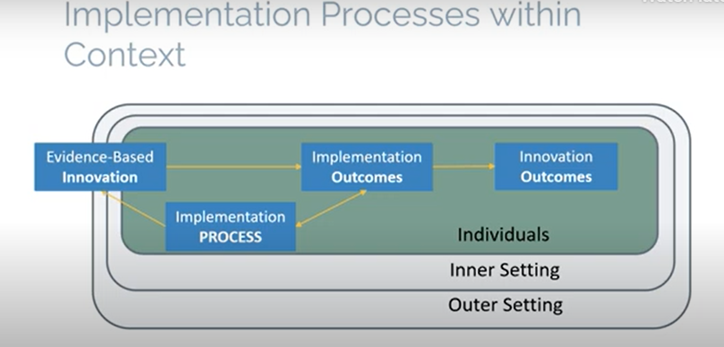
As Laura was one of the authors of the Consolidated Framework for Implementation Research (CFIR) and as this was the framework that first attracted us to Implementation Science, Laura and Caitlin then spent some time walking the Network members through the CFIR and its potential applications. The CFIR is a Framework for implementing an innovation in complex contexts, as described in Figure 1. Identifying and successfully implementing an evidence-based innovation is complex because of the need to adapt and sustain this work in light of a full understanding of the individual (visitors, staff, leaders), inner (the museum) and outer (the broader social realities) contexts; that is, taking research findings and implementing them in the specific context of a particular museum demands a deep understanding of and will be directly affected by the three contextual domains. To aid this work and support the development of methods to embed, sustain and understand the successes and failures of specific evidence-based innovations, the framework sets out the facilitators of and barriers to successful implementation across 5 domains:
- Innovation
- Inner Setting
- Outer Setting
- Individuals Involved
- Implementation Process
The CFIR provides a practical guide to assess and navigate complexity as we work through the implementation pathway. The framework helps us to think through and plan and evaluate implementation in a systematic way. Importantly, it also enables us to identify why an innovation worked. The CFIR embraces complexity but it can also enable us to simplify our approaches enough to help us get to where we need to be.
Working through the complexity
The most challenging and productive aspects of the Workshop involved thinking through some of the complexities that arise from our particular interest in Implementation Science and the specific context of museums. For example, unlike in healthcare, we do not have evidence generated in controlled trials that we want to implement consistently across complex settings. Rather, we have some limited empirical evidence of what works in specific settings and lots of descriptions of ‘best practice’ and theories that hold potential but lack rigour. We can work to map the existing research and identify the most useful ‘evidence’ and most promising best practice (an innovation framework to help us specify the innovation), but the innovations – new exhibitions and inclusive interpretations, particular forms of welcome, inclusive marketing, relationship building, opportunities to engage in particular modes of communication utilised by Visitor Services staff, for example – will remain complex, will be context-specific and difficult to pin down.
Museum evaluations – of which there are many – also don’t help us here. In museums, evaluations of the innovation will often relate to quite limited learning outcomes or be focused even more narrowly on visitor numbers. Key strategic aims to broaden audiences (increasing numbers of museums are making an explicit commitment to broadening their visitor demographics) are rarely measured in any meaningful way and we are unaware of any detailed research which seeks to identify and evaluate the effects of the varied components of the innovation or combinations of components. Indeed, the innovation is rarely specified in full, even once built/developed. Implementation tends not to be identified as a specific and separate discipline. Rather, innovations would tend to be held within project management processes. How, then, could we even begin to utilise Implementation Science and the implementation pathway and process to develop and test implementation methods if we are unclear about what will work?
Here, Laura and Caitlin set out the Hybrid Type 2 design – a route through which we can simultaneously test and refine the innovation and evaluate the implementation. Rather than approaching evidence-based innovation and implementation in a linear way, one at a time, the hybrid approach can save time, lead to the identification of more effective implementation strategies and generate greater overall learning and insight for (museum) leaders (Curran et al 2013).
Based on this, Laura and Caitlin set out a simple 4-stage Implementation Science process:
- Develop the innovation
- Implement the innovation
- Evaluate the implementation
- Evaluate the innovation
This approach raises lots of new questions and begins to define our next steps. In terms of 1. Develop the innovation, we would need clarity on what works, that is, what evidence do we have that specific interventions into museums work to broaden visitor demographics? What theories of change are we basing our work on? What are we setting out to do and who needs to be involved? At Step 2 – Implement the innovation – we would need to utilise the CFIR to identify, across all five domains, the barriers to and facilitators of success and marshal our data in order to develop and specify implementation strategies that are fit for purpose. Once implementation is underway, we would need to work with Implementation Science and Evaluation experts to develop our evaluation methodology for 3. Evaluate the implementation and, linked to this, we would need to build critically on established evaluation techniques in museums and develop new methods to 4. Evaluate the innovation. Prior to all of these steps, we would need to adapt the various tools and frameworks so that they are fit for museums and ensure that we have gleaned any clues about visitation and non-visitation from the population-level data. All of this work will generate data that we will need to analyse and track as we begin to build up our understanding of the outcomes of all this work. It will provide evidence of which innovations and implementation strategies are most effective.
Next steps
Whilst this would mark a significant step change in museums and demands development and testing in situ, it is possible that this approach could draw in the expertise necessary and create the rigour and conditions needed for the co-creation of methods and approaches to enable museums to focus on the attendance gap and gradually generate an accurate understanding of what is required – in terms of innovation and implementation – to close the gap, to sustain representative participation and scale this work up and across the sector.
So, our next phase of research will involve bringing together specific wide-ranging expertise to work out how museums can generate a focus on and become much more systematic and evidence-led in tackling the attendance and benefit gap. Our hypothesis is that we need both a detailed, evidence-based focus on the innovation and a detailed, evidence-based focus on the implementation and that each strand will have different desired outcomes and will demand evaluation. We need to work through this in an active way in the very specific context of a number of museums. However, we think that a focus on and prioritising of the attendance and benefit gap when approached through these processes, could lead to the development of a new area of museum practice and new methods, processes and understanding which could, in turn, lead to a sustained closing of the gap. Our priority now is to work with our museum partners and to convene teams of experts to develop methods and processes equal to this task.
References
Curran G.M., Bauer M., Mittman B., Pyne J.M., Stetler C., ‘Effectiveness-implementation hybrid designs: combining elements of clinical effectiveness and implementation research to enhance public health impact’, Med Care, 2012 Mar;50(3):217-26. https://doi.org/10.1097/mlr.0b013e3182408812
Damschroder, L., ‘Clarity out of chaos: Use of theory in implementation research’, Psychiatry Research, 2020-01, Vol.283, p.112461-112461, Article 112461. https://doi.org/10.1016/j.psychres.2019.06.036